The ROI of Coaching: How Investing in Yourself Pays Off in Business

How Business Case For Coaching ROI In 2025
The business case for coaching has never been stronger. In a world of constant change and disruption, the ability to adapt and to learn is a key competitive advantage. Coaching is a powerful tool for developing this ability. It is a proven and effective way to build leadership capacity, to improve team performance, and to drive organizational change. The ROI of career coaching is a key part of this business case.
Key Advantages of Coaching:
- Builds Leadership Capacity: Develops essential leadership skills for navigating complex business environments.
- Improves Team Performance: Enhances collaboration, communication, and overall team effectiveness.
- Drives Organizational Change: Facilitates the adoption of new strategies and fosters a culture of adaptability.
How Coaching Generates Returns In The Real World
Coaching generates returns in a number of ways. It can help leaders to make better decisions, to improve their communication skills, and to build stronger relationships. It can also help them to develop their strategic thinking skills, to improve their ability to execute, and to build more resilient and agile teams. For a detailed breakdown of the process, see The 90-Day Result Pathway. Learn more about me and my approach to coaching.
Coaching Impact: Before and After
Decision velocity, focus, time, and making "right" calls

One of the most important ways that coaching generates returns is by improving a leader's decision-making ability. A good coach can help a leader to clarify their thinking, to identify their blind spots, and to make more informed and effective decisions. This can have a direct and immediate impact on the bottom line.
Promotion velocity and stakeholder trust

Coaching can also help leaders to accelerate their career progression. A coach can help a leader to identify their development needs, to create a development plan, and to build the skills and the relationships they need to succeed at the next level. This can lead to a significant increase in a leader's earning potential, and it can also have a positive impact on the organization's succession planning process.
Stakeholder wins and faster approvals

Finally, coaching can help leaders to build stronger relationships with their stakeholders. A coach can help a leader to understand the needs and the perspectives of their stakeholders, and to develop more effective communication and influencing strategies. This can lead to faster approvals, to more effective collaboration, and to better business outcomes.
The 90-Day Result Pathway
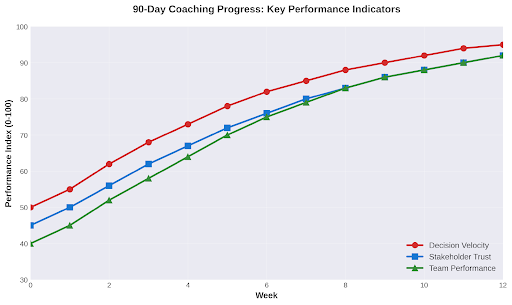
My coaching engagements are designed to deliver a clear and measurable return on investment within 90 days. We start with a baseline assessment, we track your progress against a set of weekly metrics, and we conduct a 90-day review to assess the ROI of our engagement.
The 90-Day Process:
- Baseline and First Coaching: We establish a baseline to understand your current state and define your desired future state.
- Simple Formula and Example Inputs: We use a simple formula to calculate the ROI of coaching, identifying both financial and non-financial benefits.
- Leading Indicators to Track Weekly: We define and track key performance indicators aligned with your goals.
Baseline and first coaching
The first step in any coaching engagement is to establish a baseline. We need to understand where you are now, and we need to agree on where you want to be. This is the foundation for our work together, and it is the basis for measuring our success.
Simple formula and example inputs
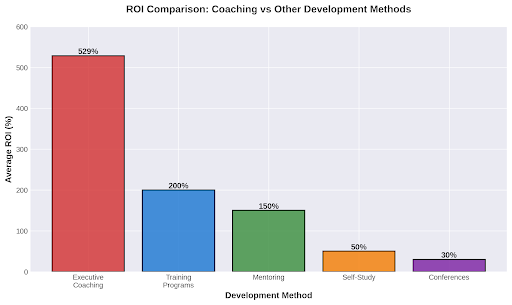
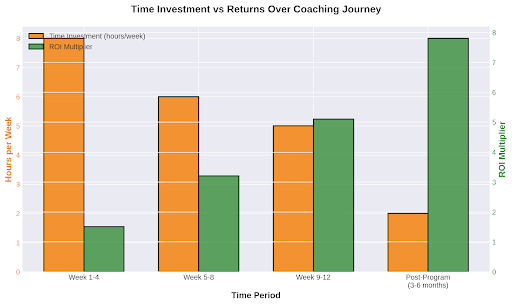
I use a simple but powerful formula to calculate the ROI of coaching. We start with the cost of the coaching engagement, and we then identify the financial and the non-financial benefits. We then use a set of conservative assumptions to calculate the net financial benefit, and we express that as a percentage of the cost.
Leading indicators to track weekly
We will work together to define a set of key performance indicators that are aligned with your goals. This could include anything from team engagement scores to 360-degree feedback to your own personal sense of well-being. The key is to track the metrics that matter most to you and your organization.
Proof Points And Case Snapshots
These stories are inspired by real client transformations and anonymised to protect confidentiality. Read more testimonials from my clients.
From Burnout to Breakthrough: A senior director at a management consulting firm was working smarter, not harder, after our coaching engagement. As she put it: "Kasia helped me work smarter, not harder, and the results speak for themselves." (Anna K., Senior Director, Management Consulting)
From Hesitation to Bold Confidence: A director of operations was hesitant to make bold decisions and struggled with confidence. Through our work together, she developed a powerful and decisive leadership style. In her words: "I no longer fear challenges—I embrace them. I approach situations boldly now, and that shift has been transformative." (Emma J., Director of Operations)
View all testimonials to see more client success stories.
Why Work With Kasia Siwosz
I am a former elite athlete, and I bring the same level of discipline, focus, and commitment to my coaching that I brought to my sport. I am a strategic partner who will challenge you, who will support you, and who will hold you accountable for achieving your goals. I am not a cheerleader; I am a coach. Learn more about my background and approach.
How to Know You're Ready — Or Not — To Stay One
My coaching is not for everyone. It is for leaders who are serious about their development, and who are willing to do the work. It is for leaders who are ready to be challenged, and who are ready to be held accountable. If you are looking for a quick fix, or if you are not willing to do the work, then my coaching is not for you.
You are ready for coaching if you are:
- Serious about your development.
- Willing to do the work.
- Ready to be challenged.
- Ready to be held accountable.
Book a focused 90 call: what to prepare
If you are ready to explore the possibility of working together, then I invite you to book a 90-minute strategic consultation. This is not a sales call; it is a working session. We will use this time to diagnose your primary challenges, to define what success looks like for you, and to determine if my direct, results-oriented approach is the right one to help you achieve your goals. Contact me to schedule your consultation.
How to Prepare for Your Strategic Consultation:
- Identify Your Primary Challenges: What are the biggest obstacles holding you back?
- Define Success: What does success look like for you in the next 90 days?
- Come with an Open Mind: Be ready to be challenged and to explore new perspectives.
Summary: Invest Once, Compound Weekly
The ROI of coaching is not a one-time event; it is a continuous process of learning and growth. The investment you make in coaching will pay dividends for years to come. It is an investment in yourself, in your career, and in your organization. Explore my coaching services to learn how we can work together.
For more insights and media coverage, visit my press media page.
References
[1] American University. (n.d.). The ROI of executive coaching.
[2] International Coaching Federation. (2024, September 3). Coaching statistics: The ROI of coaching in 2024.
[3] Forbes Coaches Council. (2023, February 24). The ROI of executive coaching: A comprehensive guide.
[4] FMI Corporation. (2025, July 3). Executive coaching: Driving real results for leaders.
[5] Velocity Advisory Group. (2025, March 21). How to measure the impact and ROI of executive coaching.
[6] Zhou, L. (2025, October 22). 70+ latest coaching statistics: ROI, growth & AI (2025).
[7] De Meuse, K. P., Dai, G., & Lee, R. J. (2009). Evaluating the effectiveness of executive coaching: Beyond ROI?. Coaching: An International Journal of Theory, Research and Practice, 2(2), 117-134.
[8] Lawrence, P., & Whyte, A. (2014). Return on investment in executive coaching: a practical model for measuring ROI in organisations. Coaching: An International Journal of Theory, Research and Practice, 7(1), 4-17.
[9] Phillips, J. J., & Phillips, P. P. (2005). Measuring ROI in executive coaching. ICF Research Portal.
FAQ
How do I calculate the ROI of coaching for my role or team?
We will work together to define a set of key performance indicators that are aligned with your goals. We will then use a simple but powerful formula to calculate the net financial benefit of our engagement, and we will express that as a percentage of the cost.
What measurable results can a 90-day coaching program deliver?
A 90-day coaching program can deliver a wide range of measurable results, including improved decision-making, increased productivity, and enhanced team performance. We will work together to define the specific results that are most important to you and your organization.
Which metrics should I track weekly to quantify coaching outcomes?
We will work together to define a set of key performance indicators that are aligned with your goals. This could include anything from team engagement scores to 360-degree feedback to your own personal sense of well-being. The key is to track the metrics that matter most to you and your organization.
What is the typical payback period for a 1:1 executive coaching engagement?
The payback period for a 1:1 executive coaching engagement can vary depending on a number of factors, including the goals of the engagement, the commitment of the client, and the skill of the coach. However, many clients report seeing a positive return on their investment within the first 90 days.
How long does it take to see financial or performance returns from coaching?
Many clients report seeing a positive return on their investment within the first 90 days. However, the full financial and performance returns from coaching can take longer to materialize. The key is to be patient, to be persistent, and to be committed to the process.
How should I report coaching ROI to senior stakeholders?
We will work together to create a clear and compelling business case for coaching. This will include a clear statement of the goals of the engagement, a clear set of key performance indicators, and a clear and conservative calculation of the ROI.
What factors reduce the effectiveness or ROI of a coaching program?
The effectiveness of a coaching program can be reduced by a number of factors, including a lack of clear goals, a lack of commitment from the client, and a poor fit between the coach and the client. This is why it is so important to choose a coach who is a good fit for you and your organization, and to be clear about your goals from the very beginning.
Ready to get started? Contact me today to begin your coaching journey.