Core Values and How to Use Them for Better Decisions

Understanding core values is one of the most powerful steps you can take in your personal development. These values act as an internal compass, guiding your choices and shaping your moral character. While many of us have a vague sense of our values in life, taking the time to consciously identify your personal core values can bring profound clarity and confidence to your decision-making. This guide provides a simple definition of what life values are and outlines a discovery process to help you live with greater intention and self respect.
Key Takeaways
• Core values are the fundamental beliefs that guide your actions and decisions, forming the bedrock of your character.
• The 5-Step Core Values Discovery Process provides a structured way to uncover your most important principles.
• Using your values as a filter for decisions reduces stress, increases confidence, and builds lasting self respect.
What Core Values Are
At their heart, core values are the principles that you hold to be of central importance. They are not fleeting preferences but deeply held convictions that dictate your behavior when you are at your best. They are the foundation of a person of good character and form the basis of your personal belief systems. Some common values examples include integrity, growth, family, freedom, and contribution, but your unique set will be personal to you.
Simple definition of values
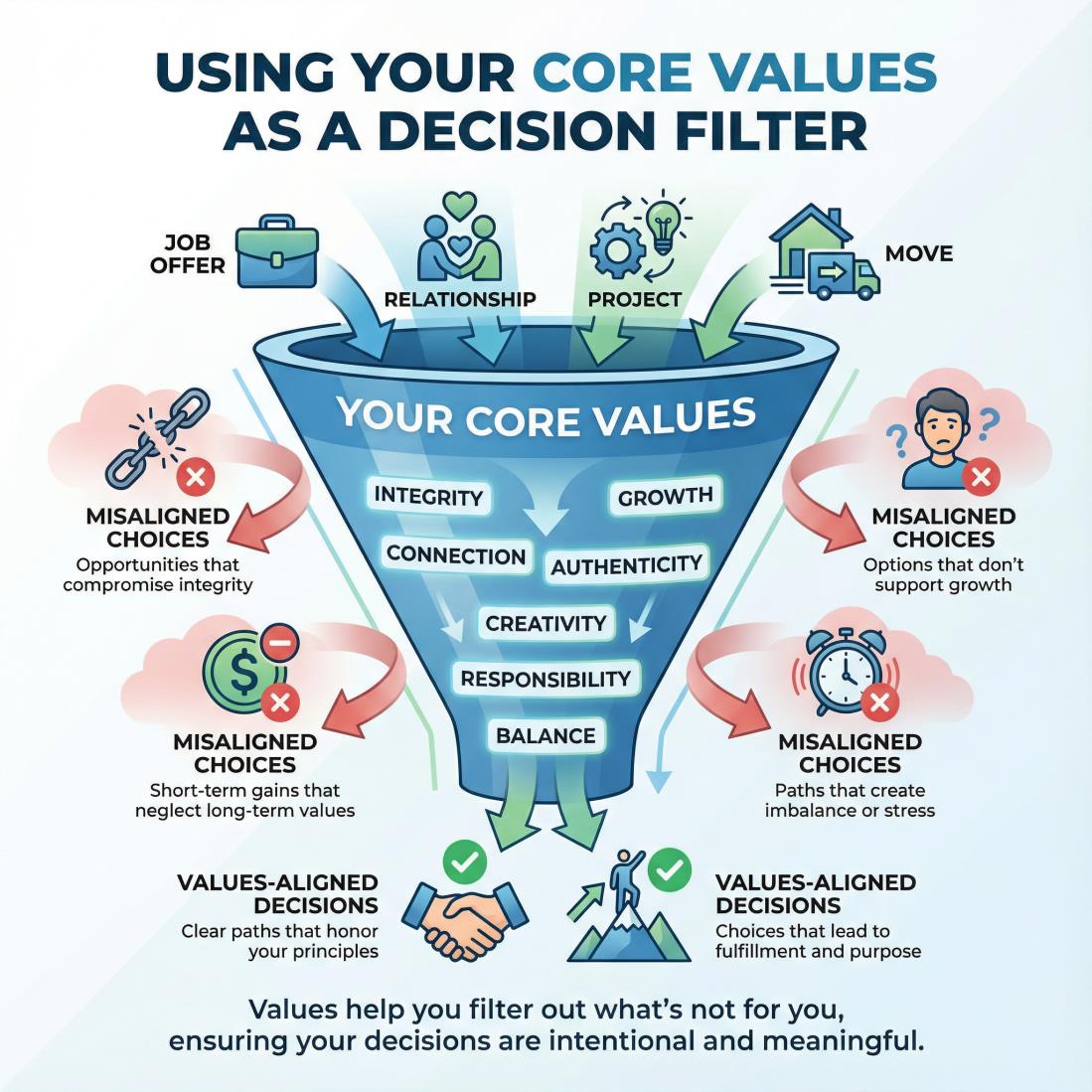
Core Values (Simple Definition): Core values are the essential principles and beliefs that are most important to you. They act as a guiding framework for your life, influencing your behaviors, decisions, and priorities. They are the measure you use to determine if your life is turning out the way you want it to, a matter of common sense for intentional living.
Why Values in Life Matter
Your values in life are the invisible force behind your actions. They are the "why" that drives the "what" you do every day. When your actions are aligned with your values, you experience a sense of congruence and integrity. When they are not, you may feel a sense of inner conflict, stress, or dissatisfaction, even if you are achieving external success through hard work.
Belief systems and behaviour
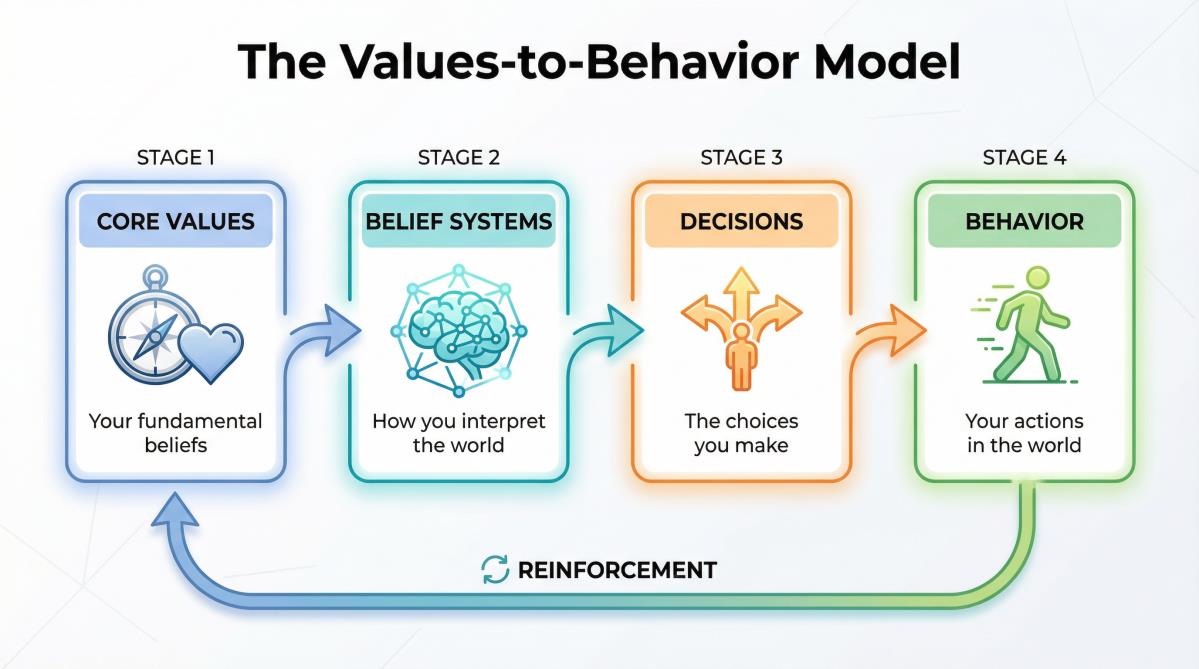
Your belief systems and core values are intrinsically linked. Your beliefs shape what you value, and what you value reinforces your beliefs. This creates a powerful feedback loop that governs your behavior, a model where Values → Beliefs → Decisions → Behaviour. By consciously choosing your values, you can intentionally shape your belief systems and, consequently, your actions, rather than operating on autopilot
The 5-Step Core Values Discovery Process
The discovery process for identifying your personal core values is a journey of self-reflection. It involves looking at your life from different angles to uncover the principles that have consistently guided you. This is not about who you think you should be, but about discovering who you already are at your core.
- Reflect on Peak Experiences: Identify two or three moments in your life when you felt most proud, fulfilled, or energized. What were you doing? Who were you with? What made these moments so powerful? The values you were honoring are often hidden in these peak experiences.
- Analyze Your Frustrations: Think about times you felt angry, frustrated, or drained. These negative emotions often signal that a core value is being violated. What was happening in those situations? What important principle was being ignored or suppressed?
- Identify Recurring Themes: Look at your notes from the first two steps. What patterns or themes emerge? Group similar ideas together. For example, do many of your peak moments involve learning something new? This could point to a value of Growth or Curiosity.
- Draft Your Core Values: Based on your themes, create a short list of 3-5 personal core values. Use a values list for inspiration if you need to, but make sure the words you choose resonate deeply with your own experiences and feelings. This requires self control to not just pick what sounds good.
- Test and Refine: For the next week, use your drafted values as a decision filter. Before making a choice, ask yourself, "Does this align with my values?" This real-world testing will help you refine your list until it feels authentic and true to you.
Using Life Values at Work
Bringing your life values into the workplace is not just possible; it is essential for long-term career satisfaction and success. When your work aligns with your core values, you are more engaged, motivated, and resilient. This alignment is also crucial for maintaining your well-being and preventing burnout.
Self respect and boundaries
One of the most powerful applications of core values at work is in setting boundaries. If you value family time, for example, you will be more likely to protect your evenings and weekends. If you value self respect, you will be more inclined to speak up when a boundary is crossed. Your values give you the justification and the courage to protect your time and energy.
When Values Conflict
It is inevitable that you will encounter situations where your core values seem to be in conflict. For example, you might value both career advancement (which requires hard work) and family time. Navigating these situations requires conscious thought and a willingness to make deliberate trade-offs.
Trade offs and priorities
When values conflict, it is not about choosing one and abandoning the other. It is about setting priorities based on the specific context and season of your life. You might decide to prioritize your career for a short period to achieve a specific goal, with the clear intention of shifting your focus back to family time afterward. The key is to make a conscious choice rather than letting the situation decide for you.
"Your core values are not just nice-to-have words on a list. They are the most powerful decision-making tool you own. When you use them, you move from a life of reaction to a life of intention." - Kasia Siwosz, Leadership & Values Coach
Coaching Support for Core Values
While identifying your core values is a significant first step, the real work lies in integrating them into your daily life. This is where coaching can provide invaluable support, helping you bridge the gap between insight and meaningful action.
Turning insight into action
A coach can help you move beyond simply having a values list to actively living your values. Through accountability and structured goal-setting, a coach supports you in making tangible changes to your habits, routines, and decision-making processes. This ensures that your newfound clarity on your personal core values translates into real-world results.
FAQ
What are core values?
Core values are the fundamental beliefs that a person holds. These guiding principles dictate behavior and can help people understand the difference between right and wrong. They also help companies to determine if they are on the right path and fulfilling their goals. A simple definition is that they are your personal, non-negotiable principles.
What are values in life?
Values in life are the principles and ideals that you consider most important. They are the foundation of your character and influence your attitudes, actions, and desires. Examples include honesty, compassion, hard work, and personal growth. They are the things you would stand for, even if it were difficult.
How do you identify personal core values?
The discovery process involves self-reflection. Consider moments when you felt most proud or fulfilled, and identify the values you were honoring. Also, think about times you were frustrated or angry, as this often points to a core value being violated. Reviewing a values list can provide inspiration, but the most meaningful values are discovered through personal experience.
How do core values improve decision making?
Core values act as a filter for your decisions. When faced with a choice, you can ask, "Which option best aligns with my values?" This simple question can cut through confusion and external noise, allowing you to make choices that are authentic to you. This process builds self respect and reduces decision fatigue.
How do you choose between competing values?
This is a common challenge. The key is to consider the context and your long-term priorities. It is not about sacrificing one value for another permanently, but about making a conscious trade-off for a specific situation. You might prioritize a value like "adventure" in your 20s and "stability" in your 40s, and both are valid.
Can coaching help you clarify life values?
Yes. A coach can guide you through the discovery process with targeted questions and exercises. They provide an objective perspective to help you see patterns in your life that you might miss on your own. Coaching is an effective way to gain deep clarity on your life values and learn how to apply them. To learn more, explore our Coaching services at https://www.kasiasiwosz.com/coaching
What is the risk of using a values list without reflection?
Simply picking words from a values list without deep personal reflection can lead to adopting values that you think you should have, rather than the ones you genuinely hold. This creates a disconnect between your stated values and your actual behavior, leading to a lack of authenticity and inner conflict.