How to Feel Better About Yourself

Learning how to feel better about yourself is a journey that goes beyond surface-level confidence. It is about cultivating a deep and resilient sense of self-worth that can withstand setbacks and silence your inner critic. For many high achievers, feeling good about yourself can be a surprising challenge, as the same drive that fuels success can also lead to harsh self-judgment. This guide explores why self-esteem can falter and offers practical ways to improve self-esteem and build a stronger, more compassionate relationship with yourself.
Key Takeaways
• True self-esteem is about deep self-worth, not just external achievements.
• High performers often struggle with self-criticism and comparison pressure.
• You can actively improve your self-esteem through intentional practices.
Why Self-Esteem Drops in High Performers
High achievers are often perceived as having unshakable confidence, but they can be particularly vulnerable to low self-esteem. The very traits that drive them to succeed diligence, high standards, and ambition can become a double-edged sword, leading to a cycle of self-criticism and anxiety.
Overcontrol through self criticism
Many high performers use a self-critical inner voice as a tool for motivation, believing it keeps them sharp and prevents complacency. However, this constant stream of negative self-talk can become a form of overcontrol, where every minor mistake is seen as a catastrophic failure. This pattern erodes self-worth over time, making it difficult to feel good about yourself regardless of your accomplishments.
Comparison pressure
In a hyper-connected world, it is easy to fall into the trap of comparing your own journey to the curated highlight reels of others. For high performers, this can be especially damaging, as they often measure their success against a constantly shifting and unrealistic standard. This relentless comparison fosters a sense of inadequacy and diminishes the value of their own hard-won achievements.
What Feeling Good About Yourself Looks Like
Feeling good about yourself is not about arrogance or perfection; it is about a quiet, internal sense of peace and self-acceptance. It is a state of being where you can acknowledge your strengths and weaknesses without harsh judgment, and where your self-worth is not
dependent on external validation. This is the foundation of the self-esteem loop model, where positive self-perception fuels positive action.

Self respect in practice
Self-respect is self-esteem in action. It manifests in the daily choices you make to honor your own needs and values. Here are some examples of what self-respect looks like in practice:
• Setting Boundaries: Saying "no" to requests that drain your energy or compromise your values.
• Prioritizing Self-Care: Making time for rest, hobbies, and physical activity to support your well-being.
• Forgiving Yourself: Acknowledging mistakes without letting them define your self-worth.
• Celebrating Your Wins: Taking time to recognize and appreciate your own efforts and accomplishments, no matter how small.
Patterns That Keep Self-Esteem Low
Low self-esteem is often maintained by powerful, ingrained mental habits. Recognizing these patterns is the first step toward breaking free from them and building a healthier inner world. The Confidence vs Self-criticism cycle illustrates the two paths these patterns can take.

Negative self talk loop
The negative self-talk loop is a destructive cycle where a trigger event leads to critical thoughts, which in turn create negative emotions and self-sabotaging behaviors. For example, a small mistake at work can trigger the thought, "I always mess things up," leading to feelings of shame and a desire to avoid similar tasks in the future. This avoidance reinforces the initial belief, strengthening the loop.
Perfection rules
Perfectionism sets impossibly high standards for every aspect of life. It operates on a set of rigid "rules" that dictate you must never fail, never be criticized, and never be less than perfect. Since these rules are impossible to live by, they create a constant sense of failure and inadequacy, making it impossible to feel good about yourself.
Five Ways to Improve Self-Esteem
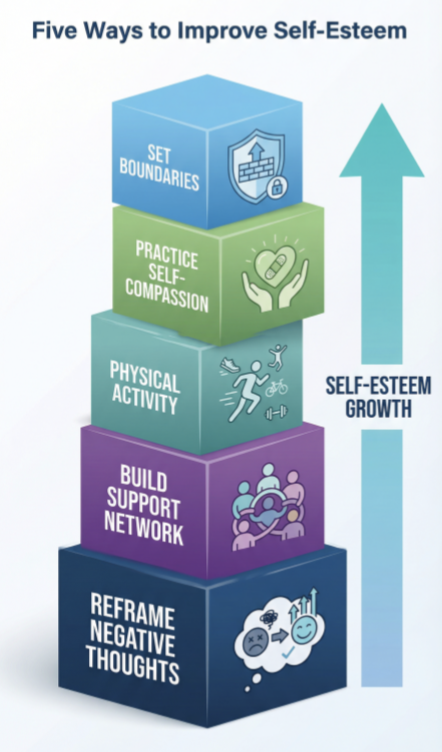
Improving your self-esteem is an active process that involves changing your thoughts and behaviors. Here are five practical, evidence-based strategies you can start using today.
Reframe negative thoughts
The first step is to become aware of your negative thoughts. When you catch yourself in a moment of negative self-talk, challenge the thought. Ask yourself: Is this thought 100% true? What is a more compassionate or realistic way to view this situation? This practice helps you reframe negative thoughts and break the cycle of self-criticism.
Build support network
Surround yourself with people who uplift and support you. A strong support network can provide encouragement, offer different perspectives, and remind you of your worth when you are struggling. Make an effort to connect with friends, family, or a mentor who believes in you.
Use physical activity as mood support
Regular physical activity is a powerful tool to improve mood and reduce feelings of anxiety and depression. Exercise releases endorphins, which have mood-boosting effects. Find an activity you enjoy, whether it is walking, dancing, or yoga, and make it a consistent part of your routine.
"True confidence isn’t the absence of fear; it’s the willingness to feel the fear and take action anyway. It’s about trusting yourself to handle whatever comes your way, and that trust is built through small, consistent acts of courage and self-respect." - Kasia Siwosz, Confidence & Self-Esteem Coach
Confidence at Work
Building confidence at work is not just about your performance; it is about how you navigate your professional environment. The confidence connection at work is the intersection of clear boundaries, visible contributions, and a strong support system.
Boundaries and visibility
Setting firm boundaries protects your time and energy, preventing burnout and resentment. This allows you to focus on high-impact work, increasing your visibility. When you consistently deliver valuable contributions and are not afraid to share your successes, you build a reputation for competence and reliability, which naturally boosts your confidence.

Coaching Support for Self-Esteem
While self-help strategies are powerful, sometimes you need personalized support to make lasting changes. Coaching provides a structured, supportive environment to explore thoughts, challenge limiting beliefs, and build sustainable confidence.
Behaviour based confidence
Kasia’s coaching focuses on a behaviour-based approach to confidence. Rather than just talking about feeling better, you will work together to take small, consistent actions that build real-world evidence of your capabilities. This practical approach creates a powerful feedback loop: action builds confidence, and confidence fuels further action. See what others have achieved on our Testimonials page.
FAQ
How do you start feeling good about yourself again?
Start small. Pick one simple, positive action you can take today. It could be going for a walk, completing a small task you have been avoiding, or reaching out to a friend. The goal is to create a small win that you can build on. Acknowledging this effort is a crucial first step to feeling good about yourself again.
Why does negative self talk feel convincing?
Negative self-talk often feels convincing because it is rooted in long-held beliefs, many of which were formed in childhood. The brain also has a negativity bias, meaning it pays more attention to negative experiences than positive ones [2]. This combination can make critical thoughts feel like undeniable facts, even when they are distorted.
What are practical steps to improve self-esteem today?
Here are three things you can do right now:
- Write down three things you have accomplished in the last week, no matter how small.
- Do 15 minutes of physical activity to improve mood.
- Unfollow a social media account that makes you feel bad about yourself. These small actions can create an immediate shift.
How do you feel better about yourself after a mistake?
First, practice self-compassion. Acknowledge the mistake without judgment and remind yourself that everyone makes them. Then, reframe negative thoughts by focusing on what you can learn from the experience. Instead of saying, "I am a failure," try, "I learned that this approach does not work, and now I can try something different."
How do you stop being self critical at work?
Start by tracking your critical thoughts. Keep a log of when they occur and what triggers them. Then, challenge those thoughts with evidence. Are you really "terrible" at your job, or did you just make one mistake? Also, make a conscious effort to celebrate your small wins and share them with your manager or a trusted colleague to build a more balanced perspective.
Can coaching help with confidence and self-esteem?
Absolutely. Coaching provides a structured and supportive environment to identify the root causes of low self-esteem and develop practical strategies to build confidence. A coach can help you set realistic goals, challenge limiting beliefs, and hold you accountable for taking action. To learn more, explore our Coaching services.
When should you consider therapy for self-esteem issues?
If your low self-esteem is linked to severe depression, anxiety, past trauma, or is significantly impacting your ability to function in daily life, therapy is the more appropriate choice. A therapist can provide clinical treatment for underlying mental health conditions. If you are unsure, you can Contact Kasia for a consultation to determine the best path for you.